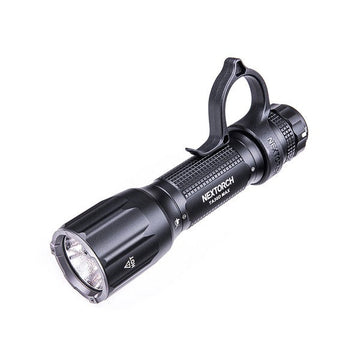
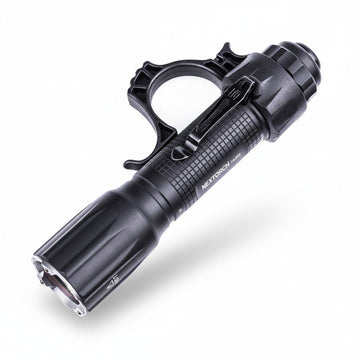
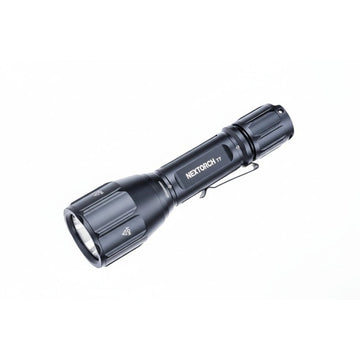
NEXTORCH TA21 – Dual-Light EDC Duty Flashlight – categorized for practical use
A tactical light must work under stress – not just be bright on the data sheet.
The NEXTORCH TA21 – Dual-Light EDC Duty Flashlight is designed for low-light training, duty, security, rescue, or demanding outdoor use when you need to access light quickly and in a controlled manner.
The practical difference lies in switch logic, grip, momentary light, and mode guidance. A light you have to search for in the dark is not a duty light.
Why this specific product?
✔ Dual-Light: White light + true red light
✔ White light: up to 1,300 ANSI lumens (manufacturer's specification)
✔ Red light: up to 150 ANSI lumens (manufacturer's specification)
✔ Range: up to 160 m (manufacturer's specification)
✔ Mode selector switch with four defined operating modes
✔ TAC Mode: Momentary light + instant strobe via tail switch (manufacturer's specification)
Role Clarification: White light plus red light in a compact duty flashlight
TA21 is strong when you need to switch between control and maintaining night vision. White light provides details, red light helps with maps, equipment, vehicles, or areas without disrupting dark adaptation as much. It's not a pure hunting colored light, but a versatile EDC/duty light.
Why this product?
The decisive point is not the individual technical specification, but the benefit in the process. TA21 is intended to make your setup more controllable: quicker to hand, easier to operate, cleaner to mount, or more reliably deployable.
- You clearly recognize the intended use and do not confuse the product with a generic solution.
- You can assess before buying whether it suits your workflow.
- You get a concrete classification of when this product makes sense – and when another NEXTORCH product would be better.
The difference from an everyday flashlight:
❌ Everyday flashlight: bright, but often wrong switch and too many modes
✔ Duty flashlight: defined access, momentary light, low-light capable operation
Instructor / User Tip:
Test TA21 not in isolation, but in your actual setup: with gloves, belt, holster, helmet, backpack, weapon or tool – depending on what you use it for.
If access, operation or mounting only works under ideal conditions, the setup is not yet complete.
Most Important Features
- Dual-Light: White light + true red light
- White light: up to 1,300 ANSI lumens (manufacturer's specification)
- Red light: up to 150 ANSI lumens (manufacturer's specification)
- Range: up to 160 m (manufacturer's specification)
- Mode selector switch with four defined operating modes
- TAC Mode: Momentary light + instant strobe via tail switch (manufacturer's specification)
- Integrated USB battery: 800 mAh, directly rechargeable (manufacturer's specification)
- FR-1 Guide ring included for more stable handling
- IPX8: waterproof up to 2 m (manufacturer's specification)
- Titanium glass breaker with nano-ceramic elements (manufacturer's specification)
Our Assessment
TA21 is particularly strong when you correctly categorize its specific purpose. Many bad purchases are not due to poor products, but due to false expectations: searchlights, duty flashlights, helmet lights, holsters, batteries, or multi-tools all serve completely different purposes.
From a Black-Raptor perspective, what counts is: Does the product fit into your workflow? Can you operate it under stress? Does it positively change your setup? If these questions are answered with yes, it is more than an accessory – it becomes a real working component.
Suitable for
-
Professional users: when operation, robustness, and repeatability are more important than pure aesthetics.
-
Instructors & Trainers: when processes need to be demonstrated, tested, and standardized.
-
Outdoor and field users: when equipment needs to function in darkness, weather, and motion.
-
Setup-oriented users: when every part should have a clear place and purpose.
Why exactly for you?
If you are not looking for a product that just "somehow fits," but a solution with a clear task in the system, TA21 is the right choice.
Important Note:
Powerful lights can cause glare and generate heat. Do not shine directly into eyes, do not cover when switched on, and test before use with gloves, equipment, and real lighting conditions.
Low-Light Scenarios from Practice
Close-range control:
Not every situation needs turbo. Indoors, in a vehicle, or in dense terrain, too much light often causes self-blinding. Deliberately train low and mid modes.
Momentary light instead of continuous light:
For searching and control, short, targeted light is often more useful than continuous light. The switch must be intuitive – with gloves, cold fingers, and under stress.
Instructor check:
Have users draw the light from a holster or bag and find the desired mode without eye contact. If this doesn't work, the setup is not yet complete.
Practical tip on light output:
More lumens are not automatically better. In confined spaces, on reflective surfaces, or in fog/rain, too much light can work against you. Therefore, deliberately train low and medium settings – turbo is a tool, not a permanent state.
Technical Data
- Light output: 1,300 lm white / 150 lm red (ANSI, manufacturer's specification)
- Range: up to 160 m (manufacturer's specification)
- Power supply: integrated USB battery 800 mAh (manufacturer's specification)
- Water resistance: IPX8 up to 2 m (manufacturer's specification)
- Length: approx. 100 mm (manufacturer's specification)
- Glass breaker: Titanium with nano-ceramic elements (manufacturer's specification)
Scope of Delivery
- NEXTORCH TA21 flashlight
- FR-1 guide aid
- Stainless steel retaining clip
- Wrist strap
- USB battery (800 mAh, integrated)
- USB charging cable
- Operating instructions
FAQ
What makes a tactical flashlight better than a normal flashlight?
Not just brightness, but switch logic, momentary light, usability under stress, and robust construction.
Why is momentary light important?
You can briefly check without continuously over-illuminating your position or the area.
What should I pay attention to during training?
Finding modes blindly, operating with gloves, and consciously distinguishing between low, high, and strobe.
Especially with tactical flashlights and low-light equipment, it's not just the lumen rating that matters, but the switch logic, usability, and light discipline in real-world applications.